Boots, Verges and the Written Record: Site Access Through a Wet-Build Winter

Photo: U.S. Navy 22NCR by Chief Petty Officer Justin Stumberg, Public domain, via Wikimedia Commons
Every renovation looks tidy on paper. On the ground, in January, it looks like a delivery of grey-brown slurry across a shared driveway and a grass verge that will not recover before Easter. None of this is unusual, and none of it is inevitable. What decides whether a wet-weather build is merely inconvenient or genuinely damaging — to surfaces, to drainage, and to the goodwill of the people next door — is the amount of thinking done before the ground is opened.
Site access is rarely the most expensive line in a renovation budget, but it is among the most visible. It is also the part of the project the client, rather than the contractor, most often owns in the eyes of neighbours. Treating it as a planning task in its own right, with its own decisions and its own record, pays for itself many times over by March.
Setting the Terms Before the Ground Opens
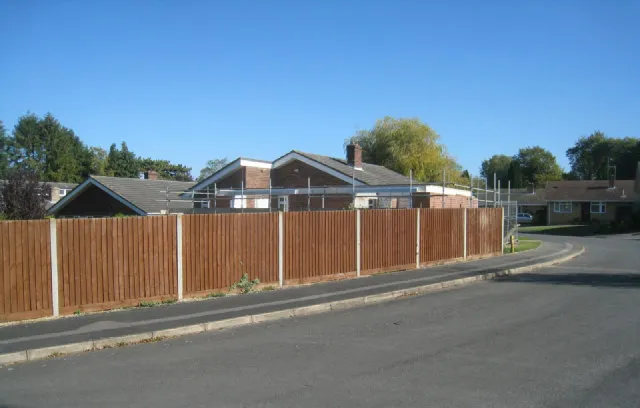
The most useful hour of the whole project may be the walk-around conducted with the contractor a fortnight before the start date. Its purpose is not to admire the drawings but to look at the road, the pavement, the verge and any shared surface, and to put on paper what condition each is in today. Date-stamped photographs taken from the same few standing points are worth more than any description. If a neighbour's wall is already cracked or their drive already rutted, that fact should be recorded while it is still someone else's problem.
This is also the moment to establish who is responsible for what. On an adopted road, the highway authority has an interest in anything placed on the carriageway or footway: skips, materials, scaffolding, hoarding and temporary crossings all have their own consent regimes, and a dropped kerb or a temporary footway crossing is not a decision for the builder alone. Under the Highways Act 1980 the deposit of mud on the highway is the responsibility of the person responsible for the works, and a council can require its removal and recover the cost of doing so. That is a straightforward commercial risk as well as a legal one, and it belongs in the contract, not in a conversation on the pavement afterwards.
Choosing a Surface That Will Still Be There in March
A British winter will find every weakness in a temporary surface. The choice is essentially between three options, and the right one depends on the weight and frequency of what will cross it.
Trackway panels — steel or composite matting laid over a geotextile separator and a blinded sub-base — are the workhorse solution for driveways, soft ground and any route a concrete wagon or a grab lorry will use. They are hired by the month, they can be lifted and relaid as the site changes, and they spread load well enough to protect both the surface beneath and the vehicle above. A grass protection mesh is a different product with a different job: it will take foot traffic and a light van, but it will not survive a delivery of blocks.
Where the standing area is permanent site rather than a route, a properly built hardstanding of compacted Type 1, laid to a fall and drained, will outperform anything laid in a hurry. A simple brushing strip of clean stone at the gate, twenty or thirty square metres at most, does more to keep the road clean than most people expect.
The Spoil Problem Nobody Budgets For
Excavated material bulges. Soil that came out of a trench at one cubic metre will occupy appreciably more than that once it is in a heap, and a winter heap is heavier, wetter and harder to move than a summer one. Skips and muck-away lorries should be arranged before the dig begins, not booked once the pile has become an obstacle.
Spoil should never be stockpiled on a verge, a footway or a neighbour's land, however briefly. Beyond the legal position, it is the single most reliable way to turn a cordial relationship into a formal one. Where material is to be retained on site for later use, it needs a defined area with a membrane beneath it and sheeting above; where it is being removed, the contractor should be able to say where it is going and confirm that the receiving site is licensed to take it.
Water, Gullies and the Run-Off Question
Mud on a road is a nuisance. Mud in a gully is a flood. A single blocked gully can put a junction underwater in a heavy downpour, and the resulting complaint will be traced back to the nearest building site with impressive speed. Silt traps, settlement before discharge, and a rule that no washout water — concrete especially — goes anywhere near a surface water drain are basic housekeeping, not optional extras. Pumping to a watercourse requires consent and should never be improvised on a Friday afternoon.
A wheel wash is the ideal, but a brushing station, a hose and an operative with a broom at the point of exit will satisfy most reasonable expectations. The road outside the gate should be swept at the end of each working day, not at the end of the project.
The Human Dimension
Neighbours tolerate a great deal when they know what is happening and whom to ask. A short letter before the start, a named site contact with a working mobile number, agreed delivery hours, and a commitment to keep the footway passable will prevent most of the friction that a wet build otherwise generates. Reversing alarms at half past seven and floodlights left on overnight are avoidable irritations that carry disproportionate weight.
The Christmas shutdown deserves its own plan. Before the site goes quiet, the road should be swept, the trackway checked, the skips removed or covered, and any loose material secured against wind and rain. A site left tidy over the break starts January with credit in the bank.
A Weekly Routine, Not a One-Off Effort
Mud management works best as a short, recurring task: a Friday sweep, a photographic log, a glance at the gullies, and a brief review with the contractor of anything that has changed. Written into the contract as a priced item with a named person responsible, it stops being a favour and becomes part of the programme.
The surfaces outside a site are the part of the project the public actually sees. Looking after them is not decoration. It is the difference between a build that the street endures and one it resents — and, in practical terms, between a driveway that can be handed back in April and one that has to be rebuilt.