What the First Hard Frost Reveals: Auditing Brickwork Before Small Faults Become Structural Ones

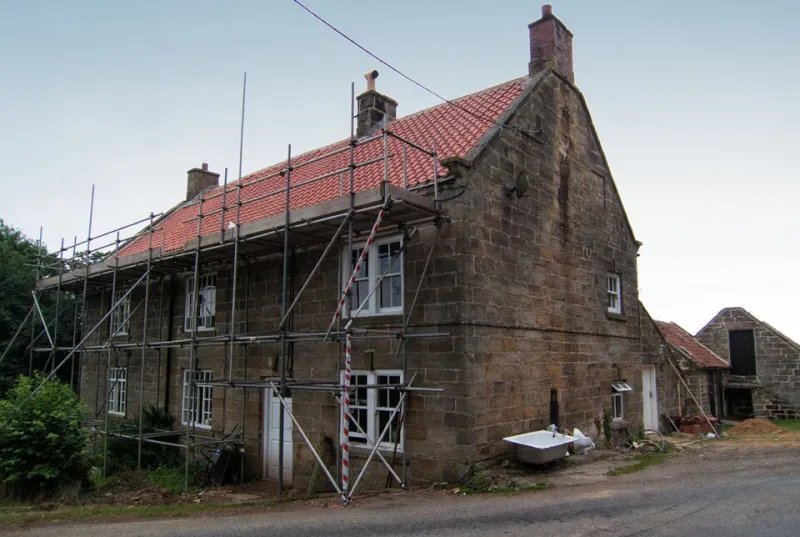
Photo: spalled brickwork frost damage old brick wall UK house, via vefeed.com
By the first week of November most UK homes have already taken a light frost, and the walls that face the prevailing south-westerly will have been wet and cold at the same time. That combination is what matters. Water sitting in the pore structure of a brick or a mortar joint expands by roughly nine per cent when it freezes, and the pressure is enough to shear off the face of the brick or crumble the pointing. One winter does very little. Ten winters, with a leaking gutter above and a cement-rich repair below, will take a sound wall apart.
The good news is that this is one of the few areas of building maintenance where an hour with a pair of binoculars and a notebook genuinely pays. Frost damage is progressive and it is visible long before it is expensive.
The mechanism, briefly
Bricks vary enormously in how much water they absorb. A dense engineering brick may take up very little; a soft, hand-made or reclaimed brick can hold a great deal. Where a wall is saturated — because a gutter overflows, a sill has lost its drip, a downpipe discharges against the plinth, or the ground level has been raised above the damp-proof course — the freeze-thaw cycle has material to work with.
Three conditions accelerate the process: saturation, repeated cycles around zero, and a hard, impermeable mortar or coating that stops the wall drying inward. This is why older solid-walled properties, repointed in a strong cement mix some decades ago, so often show distress at the base of the wall.
A ground-level survey, in a sensible order
Work around the building rather than at random, and note the compass orientation of each elevation. South and west faces usually carry the weather; north and east faces dry more slowly and stay colder. Photograph anything of concern with something for scale — a coin held against the brick, or a tape measure in frame — and write the date on your record.
- The plinth and the lowest metre. This is the splash zone, wetted by rain bouncing off paving and often the first place to fail. Look for brick faces lost in a horizontal band rather than at isolated points.
- Sills and thresholds. Stone or concrete sills should throw water clear of the wall. If the drip groove has been painted over, or the sill has settled back towards the brickwork, water tracks into the wall behind.
- Downpipe shoes, gullies and hopper heads. A pipe discharging against the wall at ground level will saturate the plinth within a season.
- Eaves, parapets, copings and chimney stacks. The most exposed masonry on any house. Check the flaunching around the chimney pots, the condition of copings and the mortar fillets behind parapet walls.
- Lintels over windows and doors. Look for rust staining on steel, a fine crack running up from the corner of an opening, or a visible sag. A cracked lintel is a structural matter, not a maintenance item.
- Seals around openings. Modern mastic joints and foam-filled gaps fail predictably; a split bead lets water into the reveal, where it freezes against the frame.
- Garden and boundary walls. Frequently built in strong mortar with no coping and no damp-proof course, and frequently the first masonry on a property to spall.
A wooden-handled screwdriver used gently — tapped, never driven — will tell you whether a brick face is hollow and drummy or still sound. Restraint matters here: a survey that creates damage is not a survey.
Cosmetic wear versus work that should not wait
Not everything you find needs a mason. White, powdery efflorescence that brushes away is salts carried to the surface by evaporating water; it is a symptom of moisture, not a defect in itself, and the useful question is where the water is coming from. Hairline crazing in render, a single chipped brick high on a sheltered elevation, or a shallow surface scrape from a ladder are ordinary wear.
Treat the following as matters to act on before the spring:
- Joints eroded to a depth of more than about 10–15mm, or pointing that crumbles when rubbed.
- Several spalled bricks in one area, particularly at plinth level or beneath a defective gutter.
- Any stepped or vertical cracking, especially above and below openings.
- A lintel that is cracked, deflecting noticeably or staining the brickwork below with rust.
- Loose copings, failed chimney flaunching or slipped flashings — these admit water directly into the wall head.
- Hollow, drummy patches where the outer leaf has begun to detach from its backing.
Where several of these appear together on one elevation, the likely cause is a single water source rather than general old age. Find it first. Repointing a wall that is still being soaked from above is money spent twice.
The repointing question
A great deal of avoidable damage in British brickwork has been caused by well-intentioned repointing. Mortar should be weaker and more vapour-permeable than the bricks it surrounds, so that any movement and any moisture is released through the joint rather than through the brick face. A strong cement mix on soft nineteenth-century brick does the opposite: it seals the wall, concentrates Frost action in the brick, and often cracks away from the edges within a few years.
For older solid-walled properties, a lime-based mortar matched to the original is usually the right specification. Joints should be raked out to roughly two and a half times their width, not simply smeared over. Work should not be carried out when the temperature is at or below 5°C and falling, and fresh mortar needs protection from frost and from drying too quickly in wind or sun. Sealants and silicone water repellents applied over damp, deteriorating brickwork tend to trap moisture rather than exclude it, and are rarely a substitute for repairing the source.
Temporary measures that are worth taking now
Before the worst of the winter, clear the gutters and check that every downpipe discharges into a gully or soakaway well clear of the wall. Re-seat a loose length of flashing if it can be done safely. Cut back ivy and other vegetation that holds moisture against the masonry. Keep air bricks and sub-floor vents clear. Do not paint over damp brickwork in an attempt to tidy it; the wall needs to dry.
Briefing a mason for March
A useful brief is written, photographic and specific. Set out the elevations concerned, the area in square metres, the specification (mortar mix, whether bricks are to be reclaimed or new, and how they will be matched for size, colour and frog), access and scaffolding arrangements, and the expected weather window. Masonry repairs in most of the UK are best programmed between March and October. Ask for provisional sums to be identified separately from fixed prices, since the extent of decay is often only clear once the joints are opened. Agree staged payments and a return visit after twelve months.
Frost damage rewards attention in exactly the proportions it punishes neglect: a morning's inspection each November will usually save a season's repair a decade later.